Centralized Configuration in Microservices
In a microservices architecture, managing configuration separately for each service becomes difficult as the system grows.
Centralized configuration solves this problem by storing all configuration values in a central location instead of scattering them across multiple services.
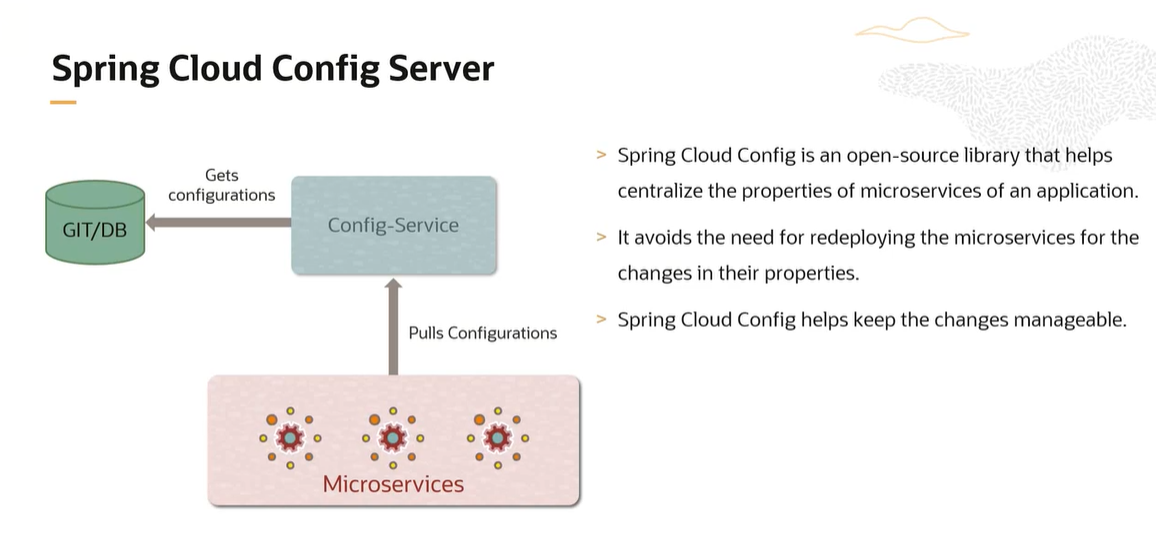
Why Centralized Configuration Is Needed
Without centralized configuration:
- Each service has its own
application.yml - Configuration duplication across services
- Updating a property requires redeployment
- Hard to manage environment-specific values
- Risk of inconsistency
In enterprise systems, this becomes unmanageable.
What Is Centralized Configuration?
Centralized configuration means storing configuration in one shared location so all services can fetch and use it dynamically.
Common storage options:
- Git repository
- Database
- Config server
- Cloud config service
In this document, we focus on:
Using a Database as configuration storage
Why Use a Database for Configuration?
Using a database provides:
✔ Dynamic updates
✔ Runtime changes (no redeployment required)
✔ Central control
✔ Audit capability
✔ Easy environment separation
Especially useful when:
- Operations team needs to change values quickly
- Feature flags must be toggled dynamically
- Thresholds / limits change frequently
High-Level Architecture
             ┌────────────────────────┐
             │    PROPERTIES TABLE    │
             │  (Central DB Storage)  │
             └───────────┬────────────┘
                         │
                         ▼
             ┌────────────────────────┐
             │  Spring Cloud Config   │
             │      Server (JDBC)     │
             │   @EnableConfigServer  │
             └───────────┬────────────┘
                         │
    ┌──────────────┬─────┴─────┬──────────────┐
    ▼              ▼           ▼              ▼
  Account      Customer      Order         Notification
Data Base table Example:
| APPLICATION | PROFILE | LABEL | KEY | VALUE |
|---|---|---|---|---|
| ACCOUNT-SERVICE | PROD | jdbc | max.transfer.limit | 500000 |
| ACCOUNT-SERVICE | PROD | jdbc | kafka.bootstrap.servers | kafka01:9092 |
Config Server Configuration (JDBC Backend)
spring:
    cloud:
      config:
        server:
          default-label: jdbc
          bootstrap: true
          jdbc:
            sql: SELECT KEY, VALUE FROM PROPERTIES WHERE APPLICATION=? AND PROFILE=? AND LABEL=?
            order: 1
This means:
- Config Server reads configuration from DB
- Uses custom SQL query
- Filters by:
- APPLICATION
- PROFILE
- LABEL
- Returns configuration dynamically
Do We Need to Expose APIs in Config Server?
No.
When using:
@EnableConfigServer
Spring Cloud Config automatically exposes internal REST endpoints.
Example endpoint:
GET /{application}/{profile}
Example:
GET http://config-server:8888/ACCOUNT-SERVICE/PROD/jdbc
Spring:
- Executes configured SQL
- Builds property source
- Returns structured JSON response
- Client service loads properties into Spring Environment
- No custom controllers are required.
How Client Microservices Fetch Configuration
Client service configuration:
spring:
  config:
    import: configserver:
(or older style using spring.cloud.config.uri)
Startup flow:
Service starts
↓
Calls Config Server
↓
Receives JSON configuration
↓
Loads into Spring Environment
↓
@Bean creation begins
After this:
- @Value
- @ConfigurationProperties
work normally.
Security Considerations
✔ Protect Config Server with authentication
✔ Restrict access (internal network only)
✔ Encrypt sensitive properties
✔ Mask secrets in logs
✔ Audit configuration changes
✔ Secure DB credentials
Never expose Config Server publicly.
Best Practices
✔ Use @ConfigurationProperties instead of scattered @Value
✔ Keep configuration separate from business logic
✔ Avoid runtime DB calls per request
✔ Cache configuration in client services
✔ Version configuration changes
✔ Document critical properties
In enterprise microservices, centralized configuration is handled using Spring Cloud Config Server backed by a database. Services fetch configuration at startup using application name and profile. Config Server executes a JDBC query to retrieve relevant properties and exposes them via built-in REST endpoints. Dynamic refresh can be achieved using Actuator or Spring Cloud Bus. This approach ensures centralized, secure, and scalable configuration management.